Envios em 48 horas🚀 Portes Grátis em Encomendas > 40€

Coastal Trail vs. Coastal Path: Which to choose?


Estimated reading time: 8 minutes
O Caminho Português da Costa é uma das rotas mais procuradas para chegar a Santiago de Compostela. A proximidade ao Atlântico, a luz aberta, o ritmo mais descontraído e a forte ligação à natureza fazem deste caminho uma escolha cada vez mais popular.
However, upon arriving at Caminha, a common and decisive question arises:
Should you follow the Coastal Way (via Valença) or opt for the Coastal Path? Although they are often confused, the Coastal Way and the Coastal Path are two different options, offering distinct experiences from Caminha, which only meet again later on the Central Way.
This guide was created to clarify these differences and help you choose the route that best suits you.
Contents
- Where the choice between Caminho da Costa and Senda Litoral arises
- What is the Coastal Route (via Valença)?
- Key features
- Strengths
- Points to consider
- What is the Coastal Trail?
- Key features
- Main differences between the Coastal Trail and the Coastal Path
- How to choose the right path for you
- How to prepare your Coastal Path
- Frequently Asked Questions
- Best-selling products
Where the choice between Caminho da Costa and Senda Litoral arises
Up to Caminha, the Portuguese Coastal Way is common to most pilgrims. The coastal stages take you from Porto to Alto Minho, always with the Atlantic as a reference point.
É em Caminha, junto à foz do rio Minho, que o Caminho se divide claramente em duas possibilidades:
- continue through Portugal, towards Valença, staying on the Coastal Way
- cross the Minho River by boat to A Guarda and continue along the Coastal Path
If you want to know in detail all the stages, distances, type of terrain, and logistics of the route in Portuguese territory, check out the full article on the Coastal Way, where each stage is explained in detail.
What is the Coastal Route (via Valença)?
Ao escolher o Caminho da Costa, depois de Caminha o peregrino vira para o interior e segue ao longo do rio Minho até Valença.
In Valença, the route connects to the Central Portuguese Way, then passing through Tui, O Porriño, Redondela, Pontevedra, Caldas de Reis, and Padrón, until reaching Santiago de Compostela.
This stage marks a clear change. The ocean is left behind and the Camino takes on a more rural and inland character.
Key features
- Continuity in Portuguese territory until Valença
- Caminha–Valença stage with undulating terrain
- Green, forest, and riverside landscape
- Earlier connection to the Central Line
Strengths
- Simple logistics, no crossings required
- Great diversity of landscape
- Early entry into the Central Path flow
Points to consider
- From Caminha onwards, direct contact with the sea ends
- A stage that is physically more demanding than the previous ones
Para aprofundar esta opção, consulta o guia completo do Caminho da Costa, onde encontras informação detalhada sobre cada etapa, dificuldades e conselhos práticos.
What is the Coastal Trail?
The Coastal Route is an alternative that allows you to prolong your Atlantic experience. In Caminha, pilgrims cross the Minho River by boat and enter Spain via A Guarda, then continue along the Galician coast.
Este percurso mantém-se próximo do mar até se juntar ao Caminho Português Central em Redondela.
Key features
- Boat crossing from Caminha to A Guarda
- Coastal path, open and exposed
- The Atlantic as a central element
- Connection with the Central Line only in Redondela
Strengths
- More days by the sea, without interruptions
- A highly sensory and contemplative experience
- Wide landscapes and introspective rhythm
Points to consider
- Dependence on boat crossings
- Greater exposure to wind and sun
- More careful planning during peak season
Se quiseres aprofundar esta alternativa, recomendamos a leitura do artigo dedicado à Senda Litoral, com etapas, distâncias e conselhos práticos.
Main differences between the Coastal Trail and the Coastal Path
| Criterion | Coastal Route (via Valença) | Senda Litoral |
| Decision point | Walk | Walk |
| Entry into Spain | Valença / Tui | The Guard |
| Connection to the Switchboard | Valencia | Redondela |
| Presence of the sea | To Caminha | To Redondela |
| Logistics | Simpler | Requires crossing |
| Landscape | Sea, river, and inland | Atlantic coast |
| Type of experience | Varied | Contemplative |
How to choose the right path for you
Não existe uma escolha universalmente melhor. Existe a escolha certa para o teu momento.
The Coastal Trail may be ideal if:
- you prefer logistical simplicity
- value landscape variety
- do you want to enter the Central Path earlier?
The Coastal Trail may be ideal if:
- the sea is an essential part of your motivation
- are you looking for a more contemplative experience
- would you mind planning in more detail?
Muitos peregrinos decidem apenas já em Caminha, depois de sentirem o corpo, o ritmo e o clima.
How to prepare your Coastal Path
Choosing the route is only the first step. Then come the practical questions: how many days, where to sleep, how to divide the stages, what to take, and how to manage the logistics.
That is exactly why we created the guide My Way Along the Coast.

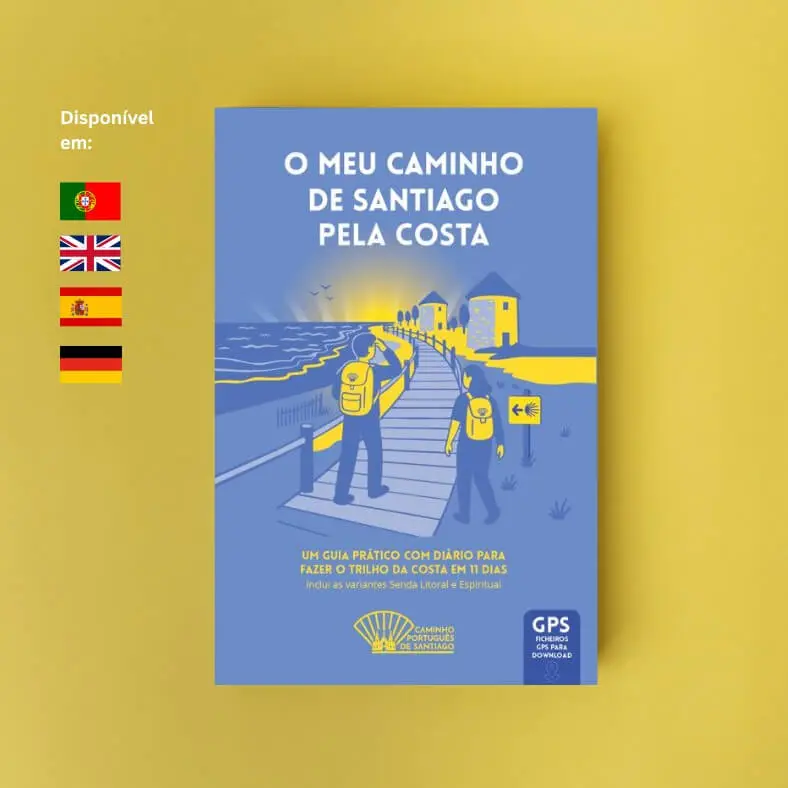
Portuguese Coastal Trail Guide
This guide accompanies you on the Portuguese Coastal Way, from Porto to Santiago de Compostela, in 11 stages—or 13, if you follow the Spiritual Variant. Based on real experiences, feedback, and valuable tips from over 110,000 pilgrims, we have gathered practical information, maps, detailed descriptions, and downloadable GPS files to help you walk the Way safely and at your own pace. It also includes everything you need to know about the Coastal and Spiritual variants, so you can choose the one that suits you best.
22,00 €
Este livro reúne toda a informação necessária para fazer o Caminho Português da Costa, incluindo:
- the journey to Caminha
- the option Walk to Valença
- the Coastal Path option to Redondela
More than just a step-by-step guide, it is a tool for:
- choose with confidence
- plan safely
- prepare for your adventure with peace of mind
If you are thinking of doing the Coastal Way, this guide could be your best companion before and during the Camino.
Frequently Asked Questions
1. Are the Coastal Path and the Coastal Trail the same route?
No. Up to Caminha, the route is the same, but from there on, there are different options.
2. Where do you choose between Caminho da Costa and Senda Litoral?
In Caminha.
3. Is it mandatory to take a boat in Caminha?
Only if you choose the Coastal Trail. On the Coastal Path, you always walk.
4. Where does the Coastal Trail join the Central Trail?
In Redondela.
5. Which option has more contact with the sea?
The Coastal Path.
6. Which is physically more demanding?
The Coastal Path is more uneven. The Coastal Trail is more exposed to wind and sun.
7. Can I decide when I arrive in Caminha?
Yes. Many pilgrims make that choice at the moment.
8. Does the Coastal Route qualify for the Compostela?
Yes, as long as you meet the distance and stamp requirements.
9. Is it possible to combine the two options?
Yes. Both are part of the Caminho da Costa design.
10. Where can I find practical information to prepare both options?
In the guidebook My Way Along the Coast, which covers both alternatives in detail.