Blog
The Spiritual Variant of Portuguese Camino de Santiago: a path inward

Estimated reading time: 9 minutes
There are paths that are taken to reach a destination. However, there are others that are taken to better understand what brought us there. The Spiritual Variant of Portuguese Camino de Santiago clearly Portuguese Camino de Santiago to the latter group. More than just an alternative route, it offers a different way of walking: with greater awareness, more silence, and a deep connection to the spiritual origins of the Camino itself.

Along the route between Pontevedra and Padrón, pilgrims pass through rural landscapes, ancient trails, monastic sites, rivers, and the sea at Ria de Arousa. Here, history, nature, and spirituality come together in a particularly harmonious way.
Therefore, for many pilgrims, it is on this route that the Way ceases to be just a succession of stages and becomes a true inner experience.
Contents
- What is the Spiritual Variant of Portuguese Camino de Santiago?
- The History of the Spiritual Variant
- The Growth, Affluence, and Profile of Pilgrims
- The Stages of the Spiritual Variant
- The Armenteira Monastery
- What is the Stone and Water Route?
- What makes the Spiritual Variant special
- Frequently Asked Questions about the Spiritual Variant of the Portuguese Camino de Santiago

What is the Spiritual Variant of Portuguese Camino de Santiago?
The Spiritual Variant of Portuguese Camino de Santiago an officially recognized alternative to the Central Portuguese Way. It runs between Pontevedra and Padrón for approximately 73 kilometers, divided into three distinct stages.
It also stands out for combining two elements that are rare in the world of St. James pilgrimages: walking on land and crossing by sea and river. This detail allows pilgrims to symbolically relive the arrival of the body of St. James the Apostle in Galicia, one of the founding episodes of the Jacobean tradition.
From Padrón, the route rejoins the central route. This allows pilgrims to continue on to Santiago de Compostela without interruption. It is precisely this combination that makes the Spiritual Variant so popular with those who want a quieter, less crowded route with a strong symbolic dimension.
The History of the Spiritual Variant
The historical basis of the Spiritual Variant is closely linked to the Traslatio Xacobea, the account describing the journey of the body of St. James the Apostle from Palestine to Galicia.
According to tradition, this crossing was made in a stone boat, crossing the Mediterranean, the Atlantic, and finally going up the Ulla River to Padrón.

Over the centuries, this episode has taken on enormous symbolic significance in Jacobean spirituality. However, it was not until 1965 that a concrete initiative was launched to preserve and promote this heritage: the creation of the Rota Xacobea do Mar de Arousa e Ulla Foundation.
The foundation began by structuring the maritime route between the ports of Ria de Arousa and the Ulla River, symbolically recreating the final part of the Traslatio. Later, the integration of this route into the Portuguese Way gave rise to the Spiritual Variant as we know it today.
In this context, many pilgrims understand the Traslatio Xacobea as a kind of "spiritual Compostela": not a physical document, but an experience that deepens the meaning of the Way and reinforces the connection to its origins.
The Growth, Affluence, and Profile of Pilgrims
For many years, it was mainly local pilgrims who traveled the Spiritual Route, or those with a very specific interest in the history of St. James. However, this situation has gradually changed.
Recently, the demand for more authentic and less crowded experiences has significantly increased the number of visitors to this route. Even so, the route remains calmer and more secluded when compared to the central route.
Those who choose the Spiritual Variant tend to value silence, the landscape, and the symbolic dimension of the Way. It is common among pilgrims who have already traveled other routes and are now looking for a more introspective experience. At the same time, it also attracts those who feel the need to slow down, walk with more presence, and listen to what the Way has to offer.
The Stages of the Spiritual Variant
The Spiritual Variant is organized into three stages, each with its own identity and a well-defined rhythm.
Pontevedra → Armenteira: from the village to silence
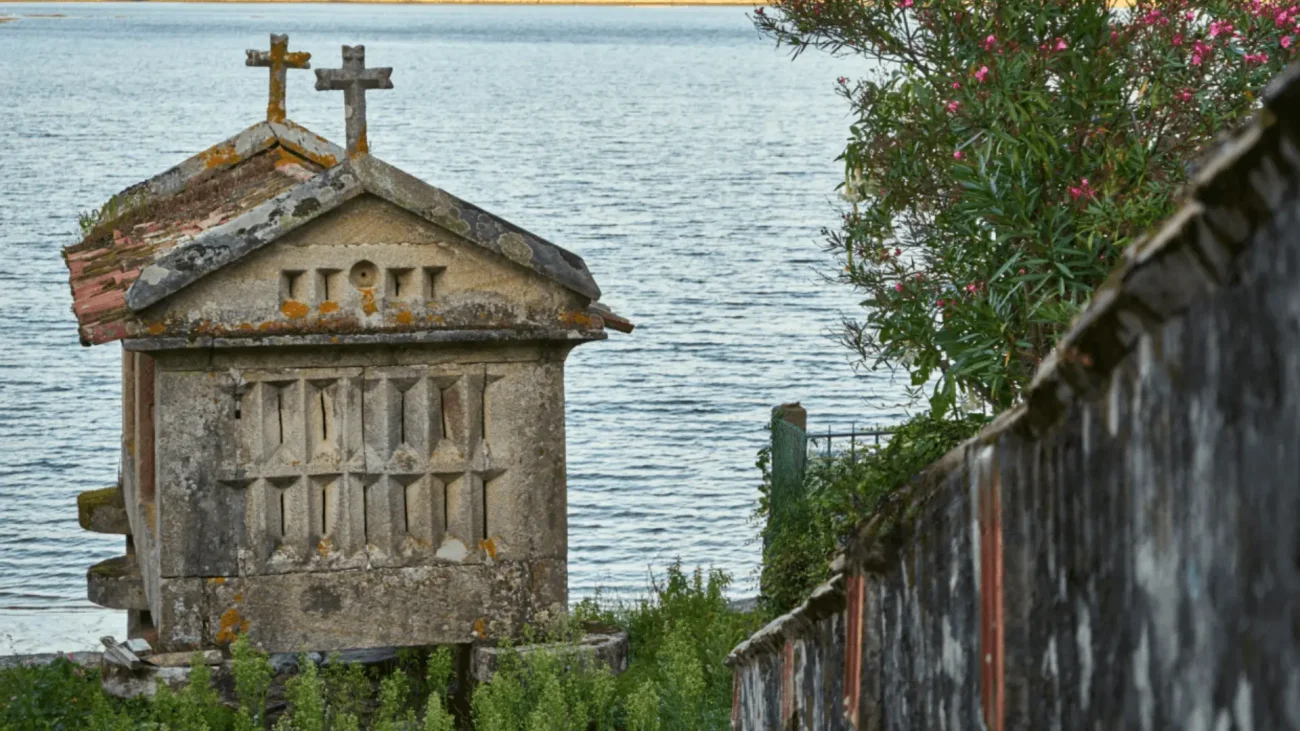
The first stage marks the transition between the urban environment and rural Galicia. In the first few kilometers, the route passes through Combarro, one of the most emblematic villages in the region, known for its granaries by the sea and its well-preserved historic center.

From there, the route gradually moves away from the coast. The greenery becomes more intense, the noise diminishes, and silence begins to take over. This environment naturally prepares the pilgrim for their arrival in Armenteira, one of the most important spiritual points along the entire route.
Armenteira → Vilanova de Arousa: the Stone and Water Route
The second stage follows the well-known Stone and Water Route, considered by many to be one of the most beautiful sections of the entire Portuguese Way.
Along the way, the path follows streams, old mills, and shaded trails. The environment is cool, green, and deeply serene. Therefore, it is almost inevitable to walk more slowly, observe more carefully, and let the rhythm of nature set the pace.
Vilanova de Arousa → Padrón: the Traslatio crossing
The third stage begins differently. In Vilanova de Arousa, pilgrims embark on a sea crossing through the Ria de Arousa and the Ulla River, symbolically recreating the Traslatio Xacobea.
The journey ends in Pontecesures. From there, the last two kilometers or so are on foot to Padrón, where the route rejoins the Central Portuguese Way.
The Armenteira Monastery
The Armenteira Monastery is one of the great spiritual centers of the Spiritual Variant. Founded in the 12th century, it maintains an atmosphere of seclusion, simplicity, and hospitality to this day.
For many pilgrims, the night spent in Armenteira becomes one of the most memorable moments of the entire Camino. The deep silence, the distance from outside noise, and the contact with a different pace of life create, almost effortlessly, a space for pause and introspection.
What is the Stone and Water Route?
The Stone and Water Route is an ancient traditional path that connects Armenteira to Vilanova de Arousa, following the natural course of the water through fertile valleys.
Along the way, you will encounter mills, small bridges, waterfalls, and trails surrounded by dense vegetation. More than just a simple connection between two points, this route offers a sensory and contemplative experience, inviting you to walk slowly, observe, and listen.
What makes the Spiritual Variant special
The Spiritual Variant stands out for integrating land and water into a single route and for reviving one of the founding stories of Camino de Santiago.
In addition, it offers a calmer pace, less outside noise, and a closer relationship with the landscape and the deeper meaning of pilgrimage. The maritime stage, rare in the Jacobean universe, combined with passing through places such as Armenteira, makes this variant a particularly transformative experience for those seeking more than just reaching Santiago.

Frequently Asked Questions about the Spiritual Variant of the Portuguese Camino de Santiago
The Spiritual Variant is an officially recognized alternative to the Central Portuguese Way that connects Pontevedra to Padrón, combining walking on land with a sea and river crossing inspired by the Traslatio Xacobea.
The Spiritual Variant is approximately 73 kilometers long, divided into three stages.
It begins in Pontevedra and ends in Padrón, where it rejoins the Central Portuguese Way.
Yes. It is an officially recognized route and valid for obtaining the Compostela, provided that the minimum number of kilometers required is completed.
It is not mandatory, but it is strongly recommended because it is part of the historical and spiritual significance of the variant.
The crossing ends in Pontecesures. From there, the last two kilometers or so to Padrón are covered on foot.
Yes. It is recommended to book the ferry crossing in advance, especially in spring and summer.
It can be done by those traveling the Camino for the first time, although it is more common among pilgrims with some experience.
The stage between Pontevedra and Armenteira is generally considered the most demanding due to some uneven terrain.
Spring and fall are the best times to visit, as they offer pleasant temperatures and fewer crowds.