Blog
5 spiritual rituals upon arriving in Santiago de Compostela not to be missed

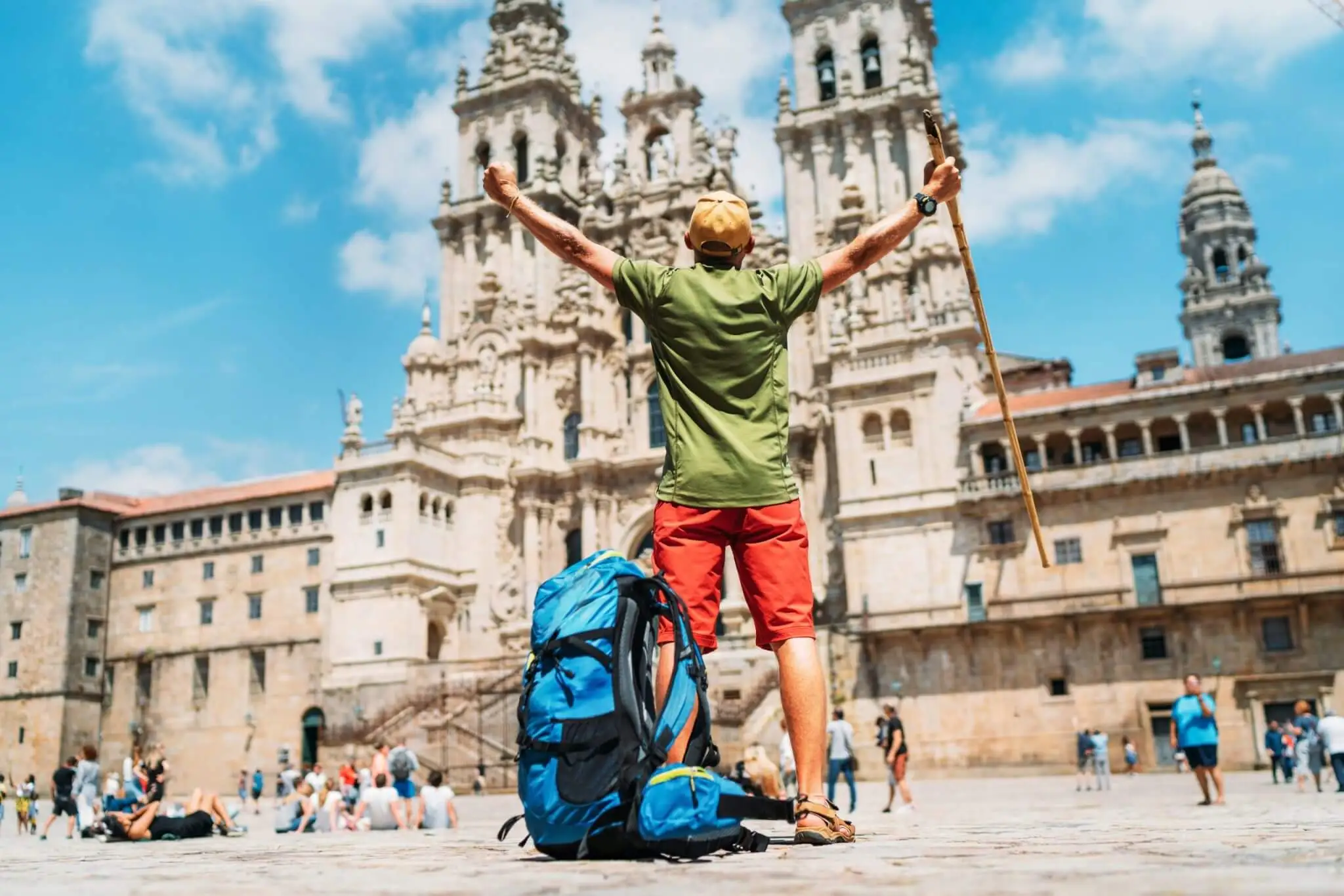
Our favorite route already has a millennium of history. Therefore, over the years it is normal for pilgrims to create their own rituals upon arrival in the city of Santiago de Compostela. Because of their intimate relationship with Catholicism, many of the ones we will mention in this article are religious. However, we will start with the arrival at the square of all meetings.

Feel the excitement in the square in which you finish the course.
Religious or not, it is certainly one of the spiritual rituals upon arrival at Santiago de Compostela in which all pilgrims participate. The Plaza del Obradoiro is the final center of the crossing named after Jesus’ apostle.
People of all creeds, colors, and paths gather here in a great congregation to observe the goal they have just accomplished. It’s time to put your bags down, take the best and the worst pictures possible, and touch the Scallop that represents kilometer zero.
Hikers always arrive where they are expected, and the Obradoiro square has been in the same place for centuries with open arms to receive each one of these adventurers. This can be seen on each of the facades of the imposing buildings in every direction.
The best known is the Cathedral of Santiago de Compostela. This religious landmark was completed in the 13th century, but as the years and architectural styles have progressed we see in every piece of art and crack why this building is unique.
In the first writing about the Way, the cathedral is described as being “53 men’s height”. An impressive length both back then and today. It is also from here that we can see the Portico da Glória. In fact, this is part of a ritual so important that later on we will talk only about it and who built it.
However, the center of the city of Compostela is not limited to the religious aspect.
Just look a little to the side and you will see the Catholic Kings Hospital. Don’t let the name fool you, as these days it is just a reminder of its past. In the old days, when it was built, this building was really a healthcare facility.
Designed exclusively for the pilgrims who flocked to the city, it was built in the 16th century by Dona Isabel of Castile and Don Fernando II of Aragão “The Catholic Monarchs”
However, despite its noble mission, from 1950 on, the place has been turned into a luxury hotel. But what is well born will always have a vocation, which is why it still receives pilgrims from all over the world. This year it has once again offered three meals a day to the first 10 pilgrims who come to Compostela. Just go to the food service and ask for the pilgrim’s room. However, if you want to keep your certificate as a souvenir, you should not use this service, as the “payment” is that document.
If you want to know more about the Compostela, we’ll talk a bit about it in the last point! Stay tuned!
To conclude, this is also the political and educational center of Galicia. Since the last buildings that make up the architectural landscape are the town hall and, on the other side, the local university’s director’s building.
So the excitement in this place is contagious in all spheres of public life. Take a deep breath when you’re here, and when the time is right, you can make your way to the Plaza de Quintana.
However, if you feel nostalgic, the region of Galicia has a webcam that is on 24 hours, always directed, at various angles, to the Plaza del Obradoiro. Follow this link to try it out.
Let’s see if the Holy Door is open.
(Until December 31, 2022, the door is open, don’t let this opportunity pass you by!)
One would expect that all the gates in Santiago de Compostela would have a Holy aura. However, it is in the Quintana square, also known for the Legend of the Ghost Pilgrim, that we find the one in the city where the walk ends.
Although they exist all over the planet, especially in countries with a strong Catholic component, this one is special. Come and find out below!
In the year the Cathedral was completed, in 1122, Pope Calixtus II declared that the next time July 25th was a Sunday, it would be a Jacobean year. In other words, in that year, whoever made a pilgrimage to this place would be absolved of their sins.
After only four years it happened, starting a millennial tradition. Almost half a century later, another pope, Alexander II, understood the importance of this crossing for all believers. Thence, he declared that the pardon would be perpetual.
However, it was not until four hundred years after this decision that the door was built. It came to represent the crossing that the faithful made in the Jacobean years: their physical, emotional and spiritual side.
The spiritual rituals upon arrival at the Camino de Santiago: The story of the Holy Door.
The opening of this door is also full of symbolism. Because it only opens in specific years, a ceremony was created to suit it. It all begins on December 31 before the Jacobean year.
Because it is locked from the inside, thus making it impossible to open it from the outside, it is the Archbishop of Santiago de Compostela himself who has the honor of initiating the celebrations of this very important season.
Although it is an ancient ritual, it is still followed by thousands of people today. It consists of knocking three times on a stone structure, attached to the door days before. When it falls, the person in charge of the parish in this town washes the floor with holy water and olive branches. He is also the first to walk through it.
Before the year ends, you repeat the process, this time in reverse. Blessing a new structure that blocks the door with incense, place it in that location, to be opened again at an indicated time.
For the sake of our virtues, due to the pandemic situation, Pope Francis has decreed 2022 still a jubilee year. Thus, if you have not yet done so, you can go through the holy door until the 31st of this year.
From here you have direct access to the main altar and, therefore, to Santiago’s tomb. In other words, you can go and fulfill one of the rituals upon arrival at Santiago de Compostela more quickly.
But you can also enter through the main entrance.
Whether it is a Jacobean year or not, the entrance through the plaza is always open, from 7 am to 8 pm. Since it is the only entrance most of the time, there may be long lines. However, you can find out exactly how long they are by following this link from the temple’s website .
This situation is more common in the summer, as there are more people. Consequently, there are more masses. Therefore, difficulties in entering are to be expected. It also doesn’t help that bringing backpacks inside the eternal resting place of the Apostle of Jesus is prohibited.
When pilgrims find this out they tend to be worried about their belongings and where to put them. The best you can do is to take a small bag with your most important documents and your wallet.
Then you can leave your backpack on the floor by the wall. There is adequate security at the door and the pilgrims tend to help each other.
It is in this spirit of sharing and mutual assistance that one of the lesser-known arrival rituals in Santiago de Compostela was created.
While waiting, the hikers chat with each other. They tell their stories, have fun, or simply listen to others. Between route photos and last-minute selfies, the journey to the city is not the last chance to make friends on the Way.
Now, before you walk inside, you need to note the following. Most of the places in the cathedral are free. However, there are some where you will have to make a paid reservation, such as the Portico da Gloria. Think the day before on what you want to see and do and you will certainly be able to do it. Use this link to buy tickets.
What are the spiritual rituals upon arrival at Santiago de Compostela in its Cathedral?
After you’ve gone through the front door (or the Holy Door, if you’ve gone in the right year) you can start asking yourself what you really have to experience here. The right answer would be everything. However, these are the most important spiritual rituals on arriving at Santiago de Compostela at this temple.
Absorb the beauty of the Great Chapel.
The larger chapel, plated with gold and features that combine various architectures into one, is the consummation of the journey so far made by many pilgrims. You will notice a statue at the top of the stairs and, most likely, with a huge line of people waiting to embrace it.
This is the representation of the Apostle of Jesus. One of the oldest spiritual rituals upon arrival at Santiago de Compostela on the pilgrimage, it consecrates the end of the crossing for many people. However, there is still so much to be done.
See a pilgrims’ sermon.
This celebration takes place every day at 12 o’clock. Although, as the number of pilgrims always increases during Summertime, more are held at that time. In the Jacobean year we can count on 4 celebrations
At the beginning of the sermon, the faithful are greeted with a list of pilgrims who have arrived in Santiago de Compostela and have been to the pilgrim’s workshop in the last 24 hours. You will learn more about it ahead.
To find out when are the sermons being held, you can visit this website so that you can plan your visit in detail.
Let yourself be amazed by the Botafumeiro.
Generally, when we imagine a sermon in the cathedral where the tomb of the apostle of Jesus is located, the first image that comes to mind is one of the best known spiritual rituals on arrival in Santiago de Compostela.
The Botafumeiro is a well-known image to all pilgrims. They dream of seeing the giant instrument flying over the temple, while hearing the names of the people who have completed the millennial trek.
This, however, supposedly serves two ancient purposes.
First, we always have the religious rituals. Since there were so many people on pilgrimages to the city named after one of the apostles, Botafumeiro works the same way as an incense burner in the hands of the priest.
This represents the attitude of the believers arriving in Santiago. Like them (and everyone reading this article), the giant censer comes closer to the Holy Spirit, by simulating a flight, buoying the whole church with the intense aroma of incense and Christ.
Secondly, the bad tongues say that the Botafumeiro was a way of softening the smell of the believers upon arrival at the cathedral. After so many months without bathing, walking, it was normal that the smell was not the most pleasant upon arrival. However, according to Professor Jose Carro Otero, this is just a myth.
This important figure from the world of the route mentions that the great censer was, and is, a fundamental part of the liturgy. It was even put into operation when the temple was empty. In fact, he humorously answers that odor could never be an issue in medieval times, since hygienic conditions were not the best.
However, despite being so important, the botafumeiro has specific days to operate. To find out more you can follow this link.
This list includes Christmas Day, Three Kings Day, and also All Saints Day on November 1. However, if you really, really want to hear a sermon with the botafumeiro flying in the middle of the cathedral you will have to send an e-mail to [email protected] asking for it.
We have already done so, and when we have the answer about the conditions, we will post them here so as to be available to all the people who want to be part of this rite.
So let’s return to one of the most interesting rituals that has been lost over the centuries. The visit to the Portico da Glória.
After 10 years of being restored, in 2018 the Portico da Gloria was once again opened to the public. This 12th Century architectural structure is one of the most important and highly regarded works of sacred art in Spain and perhaps on the planet.
Here several important figures of Christianity and the stages of life and death are represented. Today, to go inside, it is advised to make a reservation in advance. Not only is the piece of art ancient and therefore easily damaged, but there was also a tradition that did not seem to please the priests of Compostela.
Who designed and created the Portico da Glória was Mateo. Or Master Mateo, as he is known from the few historical references to which we have access of his life. Other than a lifetime pension note from King Ferdinand II of Galicia, representations in sculpturenfluence of his work on Galician art, we know little about this figure.
Even with so few accounts, Master Mateo has become an icon for pilgrims all over the world, becoming part of their rituals. This is because, among all the wonderful pieces that we can find in the portico, is the Saint of the Croques. Which, according to legend, is Mateo himself repenting for having carved himself next to God.
Over the centuries, pilgrims had the habit of knocking three times, head to head, on the statue of the old master. The idea was to pass on his intelligence and wisdom to those who were walking the Way.
However, to avoid damages, the ritual had to be forbidden and even discouraged as the sculpture was beginning to suffer from the wear and tear of time and the impact of others’ foreheads.
When you leave the cathedral, you can pick up the Compostela.
We are going to one of the last spiritual rituals on arrival in Santiago de Compostela. This way, it’s time to get your pilgrimage certificate. To do this, don’t forget, it is important to have the pilgrim’s credential with you at all times. This is because you need to prove that you have done the minimum 100 kilometers to reach Santiago de Compostela.
However, the process does not end here. You must first register at this link. In order to give the institution access to the information needed to create the long-awaited document, you have to answer a few questions.
Don’t worry, because you certainly know them well. We’ll put them all down below:
1) Mode of transport;
2) Where you started;
3) Cell phone;
4) E-mail;
5) First and last name;
6) Whether or not you want the distance certificate;
7) Sex;
8) Age;
9) Nationality;
10) Reasons for pilgrimage;
11) Type of profession.
After this, you will receive a QR code in your e-mail that gives you access to a password upon arrival at the workshop.
Nevertheless, we leave you here a heads-up on the answers:
In item 6, if you say yes, you have to pay 3 euros more. This is a certificate for the kilometers traveled to that point that you can even laminate in the surrounding stores in town.
Already when you are asked the reasons to go on a pilgrimage, you have to know that the compostela is only offered to you if you make the journey with Christian meaning to the tomb of the disciple.
That’s what it’s called in Latin:
«devotionis affectu, voti vel pietatis causa»
However, if you have trodden the path other than for a spiritual or religious reason, as you have every right to do, you will receive a Certificate.
Although it has the same name as distance, they are different. It’s also free, so you can be comfortable when you fill out the survey. You won’t be without your pilgrimage proof.
Have we missed any of the Camino de Santiago’s rituals?
These are the most common rituals of the millennial pilgrimage on the Iberian Peninsula. However, like all traditions, these change according to region, community and even person. So tell us, did we miss any ritual in Santiago de Compostela?